Key facts
- UK national body
- British Esports Federation, founded 2016
- Who owns the rules
- The game's publisher, often with a tournament organiser
- Common formats
- Best-of-one, best-of-three and best-of-five series
- Big UK events in 2026
- VALORANT Masters London (June) and the RLCS Club Championship Kick-Off (December), both at the Copper Box Arena
- Betting on matches
- Gambling, 18+ in Great Britain, licensed operators only
Competitive video gaming, organised like a sport
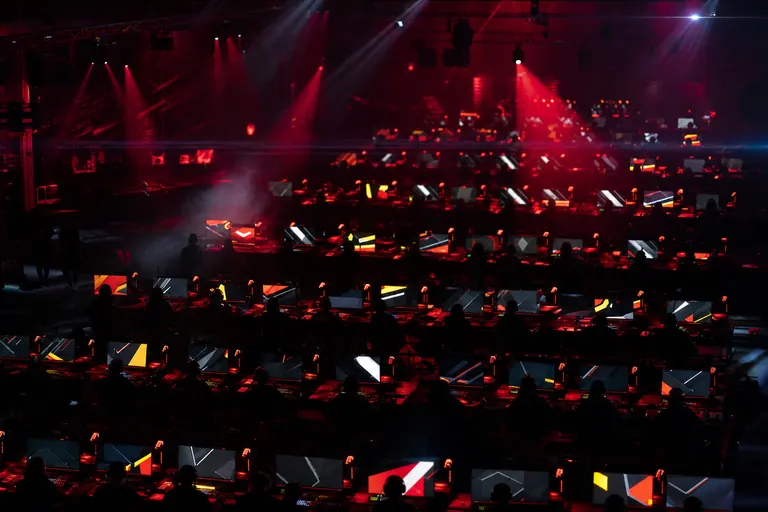
Plenty of people play games online against strangers every evening. That is not quite esports. The word describes competition with structure around it: a fixed set of rules, a schedule of matches, officials who settle disputes, and results that feed into a ranking, a league table or a bracket.
The structure is what makes it recognisably sport-like. A school team in a weekly online league, a university side playing for a national title and a professional team in a sold-out arena are all doing esports, just at very different levels.
Four things usually separate esports from ordinary online play:
- A rulebook. It sets the game version, the maps or modes allowed, the series length, what happens if a connection drops and which behaviour is penalised.
- Officials. Tournament admins and referees record results, check settings and rule on disputes. Our careers guide explains what they do.
- A format. Matches feed into a bracket, a league or a Swiss stage, so every result has a consequence. How esports tournaments work covers the formats in detail.
- An audience. Not always, but often. Matches are streamed with commentators, replays and analysis.
The kinds of games people compete in
Almost any game with a winner can be played competitively, but a handful of genres account for most organised competition. Knowing the genre tells you roughly what you are watching.
- Multiplayer online battle arenas (MOBAs): two teams of five, each player controlling one character, trying to destroy the other side's base. League of Legends and Dota 2 are the best-known examples.
- Tactical shooters: five-a-side teams taking turns to attack and defend over many short rounds. Counter-Strike 2 and VALORANT lead here.
- Hero shooters: team shooters where each character has distinct abilities, such as Overwatch 2 and Marvel Rivals.
- Sports and vehicle games: football simulations and Rocket League, a three-a-side game of football played with rocket-powered cars.
- Battle royales: large lobbies where the last player or squad standing wins, such as Fortnite.
- Fighting games and strategy games: usually one-versus-one, with long-running communities and open-entry tournaments.
For a closer look at which titles carry the biggest international events and why, see the big esports games explained.
Why publishers, not governing bodies, write the rules
Football belongs to nobody. Video games do: each one is owned by the company that makes it. That single fact shapes the whole of esports.
Because the publisher owns the game, it decides who may run competitions with it and on what terms. Some publishers run their own top-level circuits. Riot Games, for example, runs the VALORANT Champions Tour and the League of Legends World Championship. Others set the framework and license independent organisers to run events. Valve publishes a Major Supplemental Rulebook for Counter-Strike that sets how its Majors must work, including a 32-team, three-stage structure and invitations based on Valve's regional standings, while different organisers stage each event.
National bodies such as the British Esports Federation therefore play a different role from, say, the Football Association. They do not own the games or set their rules. Instead they focus on grassroots competition, education, safeguarding and representing the UK internationally. UK esports explained covers the British landscape.
The ladder from school club to arena stage
Most people who compete never go near a professional stage, and that is fine. Esports has the same broad pyramid as traditional sport.
- Casual and ranked play: the game's own matchmaking. Not esports in the organised sense, but where nearly everyone starts.
- School and college competition: in the UK, the British Esports Student Champs is open to students aged 12 and over at secondary schools, further education colleges and alternative provision schools.
- University competition: National Student Esports (NSE) runs the British University Esports Championship; in 2024/25, 17,800 players from more than 2,200 teams across 117 universities took part, according to British Esports.
- Amateur and open tournaments: online cups and local LAN events anyone can enter.
- Semi-professional tiers: such as VALORANT's Challengers leagues, which feed into the top level.
- Professional leagues and international events: the world championships, Majors and Masters events you see in arenas.
Each step up brings longer seasons, stricter rules and, usually, minimum age requirements set in the rulebook.
Major events on British soil in 2026
For a long time, British fans mostly watched the biggest events on a stream from abroad. 2026 has brought two significant international events to London's Queen Elizabeth Olympic Park.
- VALORANT Masters London ran from 6 to 21 June 2026 at the Copper Box Arena. Riot Games described it as the second global event of the 2026 VALORANT Champions Tour. It was London's first time hosting a Champions Tour event.
- The RLCS Club Championship Kick-Off, a Rocket League event, is scheduled for 9 to 13 December 2026 at the same arena, with 24 teams and a $2.5 million prize pool. A live audience is admitted from 11 to 13 December, according to the event's announcement.
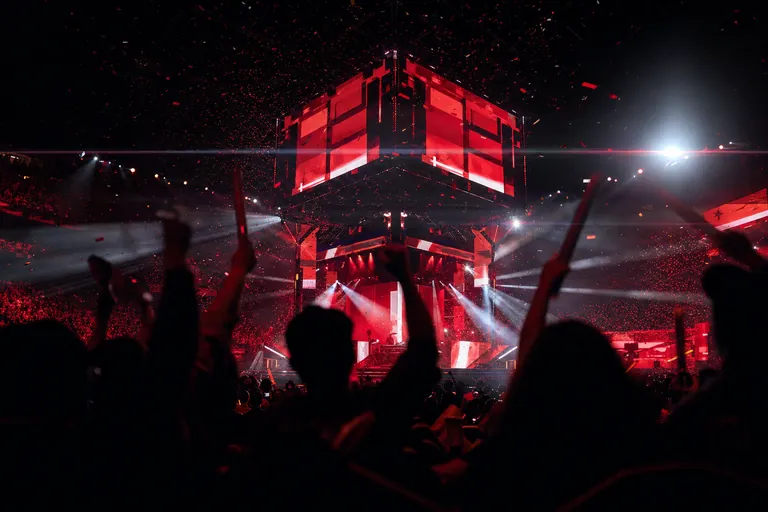
Events like these give a sense of scale: reserved seating, stage production, commentary in several languages and fans who travel from abroad. If you want to go to one, our guide to watching live covers what to expect.
Is it really a sport? Where the debate stands
The question comes up at every dinner table where esports is mentioned. There is no single official answer, and the arguments are well rehearsed.
Those who say yes point to the training, teamwork, coaching, rulebooks, officials and national bodies. Those who say no usually point to the lack of physical exertion, or to the fact that a private company owns each game.
Major sporting organisations have engaged with esports in a cautious, changing way. The British Esports Federation is the recognised member for Great Britain and Northern Ireland of the Global Esports Federation, and a founding member of the International Olympic Committee's Esports and Gaming Liaison Group. The International Olympic Committee announced plans for Olympic Esports Games with Saudi Arabia, but in October 2025 the two sides ended that partnership, and the IOC said it would develop a new approach.
Editorial view: for a newcomer, the label matters less than the structure. If you treat esports like any other competitive hobby, with training, rest and a life outside it, the debate becomes academic.
Prize money, betting and skins: keeping them apart
Headlines about esports often lead with money. At the very top, prize pools are large: the Esports World Cup Foundation announced a $75 million total prize pool for the 2026 Esports World Cup in Riyadh, spread across 25 tournaments in 24 games. Those sums go to a small number of elite teams. Most competitors play for free, for small prizes or for the fun of it.
Three money-related things are easy to confuse:
- Prize money is paid to competitors for results. Professionals may have to declare it as income; see our careers guide for the tax basics.
- Betting on esports is gambling. The Gambling Commission says the minimum legal age for gambling in Great Britain is 18 in most cases, and anyone offering betting to people in Great Britain must hold a Commission licence.
- Skins gambling uses in-game cosmetic items as stakes, often on unlicensed websites. The Gambling Commission has publicly warned parents that children may be gambling with skins without realising it.
Esports for parents explains these rules in more depth.
Your first match: how to follow along
Watching esports for the first time can feel like walking into the middle of a cricket test without knowing the rules. A few habits make it much easier.
- Pick one game. Rocket League is often recommended for newcomers because the objective, getting the ball into the goal, is obvious at a glance. That is an editorial view, not a rule.
- Check the format before you start. Is it a best-of-three or a best-of-five? Is this an elimination match? The broadcast usually shows the bracket between games.
- Listen to the casters. Play-by-play commentators describe the action; colour commentators explain why it matters.
- Learn ten words. Terms like Bo3, seed, map veto, LAN and VOD come up constantly. Our glossary explains them.
- Watch a replay. Official channels usually post full broadcasts afterwards, so you can pause and rewatch key moments.
After a couple of matches, the structure starts to make sense, and so does the excitement.
Questions
What does esports stand for?
It is short for electronic sports: organised, competitive video gaming with rules, officials and a competition format, played by individuals or teams.
Who is in charge of esports in the UK?
No single body controls it, because each game's publisher owns its competitive rights. The British Esports Federation, founded in 2016, is the national body focused on grassroots competition, education and safeguarding.
Can children take part in esports?
Yes, at grassroots level. British Esports Student Champs is open to students aged 12 and over at UK secondary schools and colleges, and some games within it have higher age limits. Professional leagues usually set minimum ages of 16 or older in their rulebooks.
Is betting on esports legal in the UK?
Betting is legal only with operators licensed by the Gambling Commission, and in most cases only for people aged 18 or over. Skins gambling websites are often unlicensed, and the Commission has warned parents about them.
Sources we checked
- British Esports — About us
- British Esports — Student Champs
- British Esports — NSE and British Esports join forces (6 Nov 2025)
- Valve — Counter-Strike Major Supplemental Rulebook
- VALORANT Esports (Riot Games) — Masters London live audience and tickets
- Inven Global — Riot Games unveils 2026 VCT schedule and format
- BLAST.tv — RLCS returns to London for the Club Championship
- Esports World Cup Foundation — 2026 prize pool and game schedule
- Video Games Chronicle — IOC ends Olympic Esports Games partnership with Saudi Arabia
- IOC — Statement on the Olympic Esports Games
- Gambling Commission — Gambling and young people
- Gambling Commission — Commission warns parents over gambling linked to video games
- British Esports — Become an esports caster or host
Last checked: 3 November 2026. Facts change; if you spot something out of date, email [email protected].